Are you thinking about changing the appearance of your car?
Are you thinking about changing the appearance of your car?
What comes to your mind first?
So what are the underlying reasons for this?
Is it the appearance or technical reasons?
The first thing on the list is of course the rim. Many drivers spend a lot of money
on alloy rims. It is very important to choose the right rim for your vehicle.
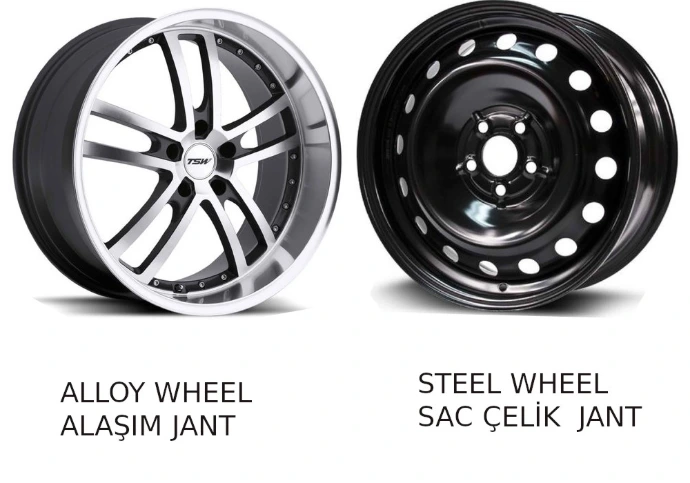
In vehicles, a choice must be made between steel and alloy rims. These two types of rims are the most common in use. There are products with carbon fiber alloy rims, but these products are quite rare and expensive.
All rims have their advantages and disadvantages. Low-end segment cars also use steel rims as standard. They are easy and cheap to mold according to demand and in different shapes.
Nowadays, vehicles are sold with alloy rims. Alloy rims are lightweight and add value to the overall appearance and performance of the vehicle. Now, let’s help you compare the advantages and disadvantages of all types of rims in terms of performance and price.
Advantages of Alloy Rims;
*Alloy rims are lightweight and provide better handling.
*Due to their lightness, they contribute to fuel economy.
*Light alloy rims put less load on the suspension, allowing for faster acceleration.
*There are many more options in alloy rims and they are much more visually appealing than steel rims.
*They provide better driving control to the driver.
*They are resistant to rust.
Disadvantages of Alloy Rims;
*Durability is an important concern for alloy wheels. Depending on the impact, alloy wheels are less durable than steel wheels.
*Alloy wheels are more expensive than steel wheels.
*They are more difficult to repair than steel wheels.
Advantages of Steel Wheels;
* For drivers looking for a cheaper yet stronger alternative, steel wheels can be a choice. They are stronger than alloy wheels and are an ideal choice for heavy machinery.
*Steel wheels come as standard parts in low segment cars.
*Steel wheels are durable, affordable, and easy to repair.
*Steel wheels are more flexible and can absorb shock effects more.
*Steel wheels are more suitable for off-road and heavy-duty use.
*The extra weight of steel wheels provides traction against slipping in winter.
Disadvantages of Steel Wheels;
*Their heavy structure reduces agility and acceleration capability, negatively affects fuel economy, and strains the suspension.
*There are not many options in terms of models.
*They are not suitable for wheels larger than 16'' in diameter.
Conclusion;
Steel wheels are more durable, cheaper, and easily repairable. They absorb shock effects more and
are resistant to impacts. Alloy wheels are lighter and provide ease of use. Additionally,
they enhance your vehicle profile and can be easily customized. On the other hand, they save fuel and add value to your vehicles.